



How 3D Virtual Tours Transform Real Estate Marketing: Data, Trends, and Proven Results

The real estate industry has entered a new era. Buyers no longer tolerate static floor plans and grainy renders as the basis for one of the most significant financial decisions of their lives. They expect to walk through a property, examine finishes, check the view from the balcony, and feel the space, all from a browser on their phone. The role of 3D virtual tours in real estate marketing has shifted from a novelty to a baseline expectation, and the data confirms what early adopters have known for years: this technology directly accelerates sales, increases prices, and eliminates inefficiencies that have plagued the industry for decades.
This article breaks down the hard numbers behind the shift, examines why off-plan property marketing demands a fundamentally different approach, and outlines what separates effective 3D real estate technology from visual gimmicks that fail to convert.
The Numbers: Why 3D Virtual Tours Outperform Traditional Property Marketing

The evidence is no longer anecdotal. Multiple independent studies across different markets have measured the concrete impact of interactive property tours on real estate transactions:
Faster sales cycles. Research analyzing MLS transaction data across U.S. markets found that listings with 3D virtual tours closed up to 31% faster than comparable listings marketed with traditional photography. A separate academic study from the University of Texas at Dallas confirmed that virtual reality tours reduced average time on market from 34 to 19 days. For developers carrying construction financing, that acceleration has a direct financial impact on holding costs.
Higher transaction values. Depending on the market, properties presented with 3D tours sold for 4% to 9% more than comparable listings relying on conventional marketing. This isn't about inflating perceived value; as the UT Dallas researchers noted, 3D tours provide a truthful reflection of a property's quality. The transparency builds buyer confidence, which reduces price negotiation.
Dramatically increased engagement. Listings featuring 3D virtual tours attract 87% more views than those without. That exposure gap compounds over time: 54% of prospective buyers will not even consider a property listing that lacks a virtual tour. For real estate developers investing in marketing, that statistic alone should reframe the cost of 3D technology as table stakes, not a premium add-on.
Reduced wasted viewings. Industry data consistently shows that 360-degree virtual tours cut unproductive site visits by approximately 40%. This benefits both sales teams and prospective buyers, filtering out mismatched prospects before they consume valuable time in a showroom.
These results align with what 3D Estate has documented across its own client base of over 400 residential developers in 17 countries: 97.3% of clients agree that properties presented in 3D are perceived by potential buyers as more attractive than those relying on traditional marketing materials. 76% of clients report increased customer engagement in their online activities, and 59% report efficiency improvements in sales and marketing exceeding 50%.
The Off-Plan Challenge: Where 3D Virtual Tours Reshape Real Estate Marketing
Selling an existing property with photography and staging is one thing. Selling a residential unit that does not yet physically exist is a fundamentally different challenge, and it is precisely where 3D virtual tours deliver their most transformative value for real estate marketing.
Off-plan property marketing requires buyers to make six-figure commitments based on abstract representations: 2D floor plans, architectural renders that may or may not reflect the final product, and brochures that flatten spatial relationships into static images. The cognitive gap between what buyers see and what they will eventually inhabit creates hesitation, longer decision cycles, and higher cancellation rates.
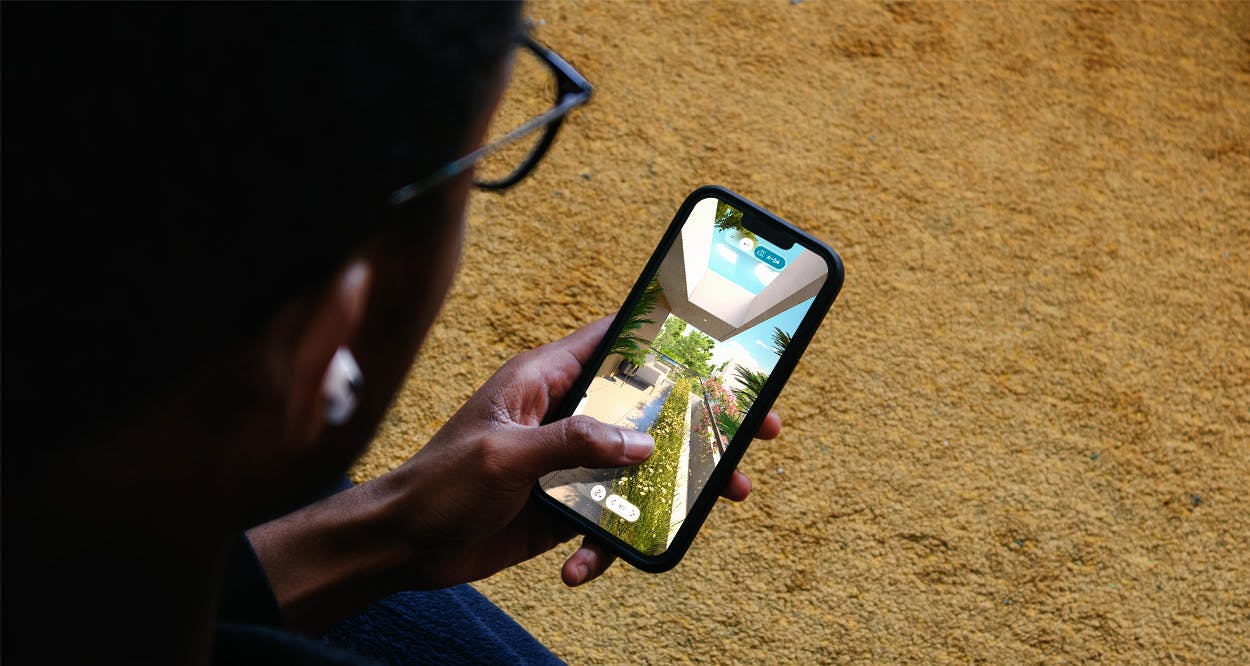
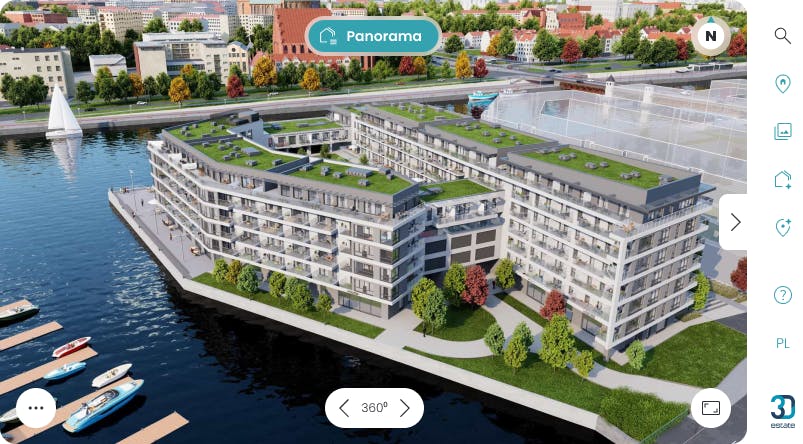
Interactive 3D applications solve this by translating architectural plans into fully navigable digital environments. Buyers can walk through apartments room by room, examine multiple interior arrangement styles, check natural lighting conditions, and view the property from every balcony and terrace. This is not a video walkthrough with a fixed camera path. It is an on-demand, self-directed experience that runs on any device with a browser, available 24 hours a day, 7 days a week.
The impact is measurable. Among 3D Estate's developer clients, 95.7% report that 3D presentation of properties before construction is finished is one of the most impactful use cases. For developments targeting international buyers or investors who cannot easily visit in person, 3D virtual tours effectively eliminate geography as a barrier to sale. A study by Redfin found that 63% of homebuyers across 32 major markets submitted an offer on a property they had not personally visited, relying entirely on virtual tools and online information.
Beyond the Tour: The Residential Sales Experience Engine
The most common mistake in real estate technology adoption is treating a virtual tour as an isolated marketing asset, a nice visual to embed on a website and forget about. The developers seeing the strongest results from 3D virtual tours integrate them into a comprehensive digital sales ecosystem that connects marketing, CRM, analytics, and sales office workflows.
This is the concept behind what 3D Estate calls the "Residential Sales Experience Engine," built on four pillars: interactive 3D technology, client experience optimization, data management through CRM integration, and business maturity with 24/7 support and legal compliance coverage.
In practice, this means a 3D Twin application does not just display a rotating model. It serves as a lead generation tool with built-in contact forms and inquiry tracking. It provides full user behavior analytics: which apartments get the most attention, what search parameters buyers use, how long they spend on the application, which devices they access it from. This data feeds directly into sales strategies, allowing teams to prioritize follow-up based on actual buyer behavior rather than guesswork.
For sales offices, the same technology powers tablet and touch-table presentations in 4K resolution, giving agents an interactive tool that replaces static catalogs and printed floor plans. The consistency between the online experience and the showroom experience builds trust and reduces friction in the buyer journey.
The Technology Gap: Photorealistic Rendering vs. Basic 360 Photography
Not all virtual tours are created equal, and the distinction matters enormously for real estate marketing effectiveness.
Basic 360-degree photography captures an existing space using panoramic cameras. It is useful for resale properties but inherently limited: it cannot show an unbuilt property, it cannot display multiple interior design options, and it cannot integrate with CRM systems or provide user behavior analytics.
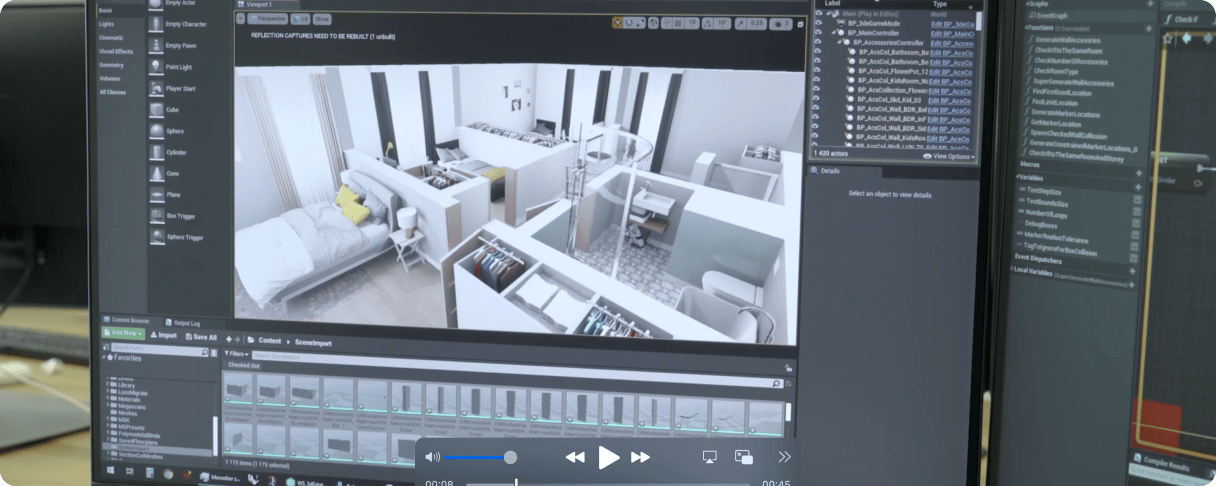
Advanced 3D visualization, powered by technologies like Unreal Engine, generates photorealistic environments from architectural data. The process is fully automated: a standard 2D floor plan goes in, and a complete 3D model with multiple interior styles, virtual tours, rotating models, top views, axonometric views, and balcony sights comes out. No manual rendering required. This automation is what makes it economically viable to produce 3D tours for every single unit in a development, not just the showpiece penthouse.
The quality difference is visible to buyers. Properties rendered with the latest game-engine technology display realistic lighting, material textures, and spatial proportions that budget 360 solutions simply cannot match. When 3D Estate's clients report that apartments presented in 3D are 2x more likely to be seen as attractive compared to traditional floor plans, the rendering quality is a significant factor in that perception gap.
Market Trajectory: From Competitive Advantage to Industry Standard
The virtual tour market was valued at $11 billion in 2024 and is projected to reach $74 billion by 2030, growing at a compound annual rate of 34.3%, according to Grand View Research. The real estate segment holds the largest market share among all virtual tour applications.
This growth curve signals that 3D virtual tours for real estate marketing are rapidly moving from competitive differentiator to baseline expectation. Buyer behavior data supports this trajectory: 75% of potential buyers already consider virtual tours a major factor in their purchasing decisions, 82% of sellers would switch to an agent or developer who offers 3D tours, and 90% of prospective buyers report being more likely to purchase a property that includes an immersive 3D tour.
Younger demographics are accelerating this shift further. Millennial and Gen Z buyers, who represent the fastest-growing segment of the real estate market, are 130% more likely to schedule a physical showing if a virtual tour is available. These digital-native buyers expect the same interactive, on-demand experience in property shopping that they encounter in every other aspect of their consumer lives.
For residential developers operating across multiple markets and countries, the operational scalability of automated 3D visualization becomes a strategic advantage. Producing high-quality virtual tours for tens of thousands of units across a global portfolio is only possible with technology that automates the rendering pipeline from 2D plans to finished 3D experiences. Manual production methods cannot keep pace with the volume, speed, or consistency that modern real estate marketing demands.
What This Means for Developers and Sales Teams
The practical implications are straightforward:
Time to adoption matters. Developers who delay 3D virtual tour implementation face an increasingly visible disadvantage in online property portals and buyer comparisons. With over half of prospective buyers filtering out listings without virtual tours, late adoption means invisible listings.
Integration determines ROI. A standalone virtual tour generates views. A virtual tour connected to CRM, analytics, and the sales office workflow generates revenue. The developers reporting the highest efficiency gains are those treating 3D technology as a core component of their sales ecosystem, not an afterthought.
Quality compounds over time. High-fidelity, photorealistic 3D tours create marketing assets that remain useful throughout the entire sales cycle and beyond. They generate content for social media, advertising, email campaigns, and portal listings from a single production investment. Each apartment visualization becomes a reusable marketing resource.
Compliance and transparency are rising requirements. Regulatory trends across Europe and other markets increasingly mandate transparency in how residential properties are marketed to buyers. Accurate 3D representations that faithfully reflect spatial reality provide a defensible standard that static renders and artistic impressions do not.

3D Twin — investment BPI Real Estate - Bernardovo
Conclusion
The question for residential developers is no longer whether 3D virtual tours improve real estate marketing outcomes. The data answers that definitively. The relevant question is how quickly and how comprehensively this technology gets integrated into the sales ecosystem. Properties with 3D virtual tours sell faster, command higher prices, attract dramatically more qualified attention, and reduce operational waste. The market is moving toward immersive digital experiences as the standard, not the exception. Developers who recognize this and act accordingly will capture the buyers who are already searching for properties this way.
Ready to see the difference? Request a demo tailored to your development. We'll show you exactly how 3D Twin works for projects like yours.
76% of developers increased online customer engagement.
Czytaj podobne
Industry
Digital Twin Technology for Residential Development
What the data shows after 2,000 delivered projects
Industry
What Is an Interactive Site Map for Multifamily?
What the data shows after 2,000 delivered projects
Industry
Innovation and Automation: How 3D Estate Is Reshaping the Rules of Real Estate Marketing and Sales